| Antique Prints | Autographs | Rare Books | Connecticut | Law |
| Maps | Miscellaneous | Newspapers & Magazines | Historical Memorabilia | Political |
| World War I Posters | World War II Posters |

|
|
|
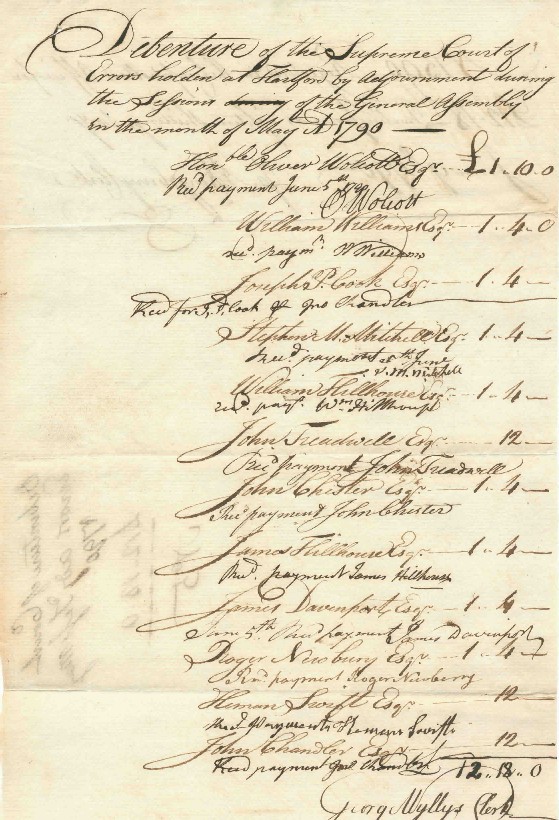
1790 Document Signed by Two Declaration of Independence Signers, Revolutionary War Heroes and Early United States Senators This fine document acknowledges payment by the signatures of twelve (12) early leaders of Connecticut, including Signers of the Declaration of Independence, Governors, United States Senators, Revolutionary War officers and soldiers, etc., all of whom where members of the upper body of the Connecticut legislature, the General Assembly, who where then called Assistants (later called Senators), and who were also members of the Supreme Court of Errors. The document on top reads "Debenture of the Supreme Court of Errors holden at Hartford by adjournment during the Session of the General Assembly in the month of May 1790" and then lists the twelve (12) members and how much they were paid with their signatures acknowledging payment. The first two individuals who signed the document, Oliver Wolcott and William Williams, also signed the Declaration of Independence. Wolcott signs our document as "Honorable" because he was the current Lieutenant Governor and later became Governor in 1796 when Samuel Huntington died in office and later got elected in his own right. Oliver Wolcott was also a member of the Continental Congress and a Revolutionary War General, whose service in the military delayed his signing of the Declaration until October 1, 1776. Williams also served in the Continental Congress and with Governor Jonathan Trumbull did much of the Revolutionary War planning for Connecticut at the famous War Office on the Lebanon Green, which was a short walk away from their homes in Lebanon. Williams was also a delegate to the Hartford convention which ratified the United States Constitution in 1788.
Many other notables also signed our document in 1790. Heman Swift was a true patriot who served in the military during the entire Revolutionary War. He enlisted on June 20, 1776, served with General Gates around Fort Ticonderoga in 1776 and was the colonel who commanded the 7th Regiment of Connecticut Line in the Continental Army in 1777 though 1781. During that period he served under George Washington and took the Oath of Allegiance at Valley Forge in 1778 and was later detached to command the Connecticut Light Infantry Battalion under General Lafayette's Division in 1780 and 1781, thus serving in the battle of Yorktown. He commanded the Second Regiment of the Connecticut Line in the Continental Army from 1781-1783, and was later promoted to Brevet Brigadier-General by Act of Congress on September 30, 1783. Stephen M. Mitchell (1743-1835) was a member of the Continental Congress 1785-1788; succeeded Roger Sherman as Connecticut's United States Senator from 1793-1795; resigned to become a Superior Court judge 1795-1814; and was a delegate to Connecticut's state constitutional convention in 1818. William Hilllhouse (1728-1816) was delegate to Continental Congress from Connecticut, 1783-86, state court judge in Connecticut, 1784-1806 and father of James Hillhouse. James Hillhouse (1754-1832) was a lawyer, member of Connecticut state house of representatives, 1780; U.S. Representative from Connecticut at-large, 1791-96 and U.S. Senator from Connecticut, 1796-1810. John Treadwell (1745-1823) was Delegate to Continental Congress from Connecticut, 1784-87; Deputy Governor of Connecticut, 1797-1809; and Governor of Connecticut, 1809-11. John Chester (1749-1809) in 1771 was a Lieutenant in the Local Militia (9th Company of the Sixth CT Regiment) which had been organized in 1640. The unit prided themselves on their uniforms "wholly blue turned up with red". In 1775, when the Lexington alarm came, Captain John Chester led a picked body of about 100 men which ranked as most selected body in the Provincial Army and were distinguished at the Battle of Bunker Hill. John Chester was commissioned Colonel in June 1776 to reinforce General Washington at the Battle of Long Island, where his battalion narrowly escaped, was engaged at White Plains, New York and retired from the army at the close of the war. George Wyllys (1710-1796) who signed our document as "Clerk" was Secretary of Connecticut having first assumed that position pro tempore in 1730 to succeed his father who had held that position. In 1734 he formally succeeded to the position of Secretary, which required him to attend every meeting of the General Assembly and held that office for a remarkable sixty subsequent years! Notwithstanding the fact that he was in active sympathy with the loyalist element during the Revolutionary War, his tenure of office as Connecticut Secretary was not interrupted. He was also town-clerk of Hartford from 1730 until his death, a tenure of 66 years! He also served as captain of militia in 1738, and held a commission of lieutenant-colonel in the French and Indian War in 1757. James Davenport (1758-1797) a lawyer was a member of the Connecticut state house of representatives, 1785; state court judge in Connecticut, 1792; U.S. Representative from Connecticut at-large, 1796-97 until his death. Roger Newbury's (1735-1814) record is not well reported but the inscription on his gravestone as copied from the Old Burial Ground, Windsor, CT in 1842 by Samuel H. Parsons says:
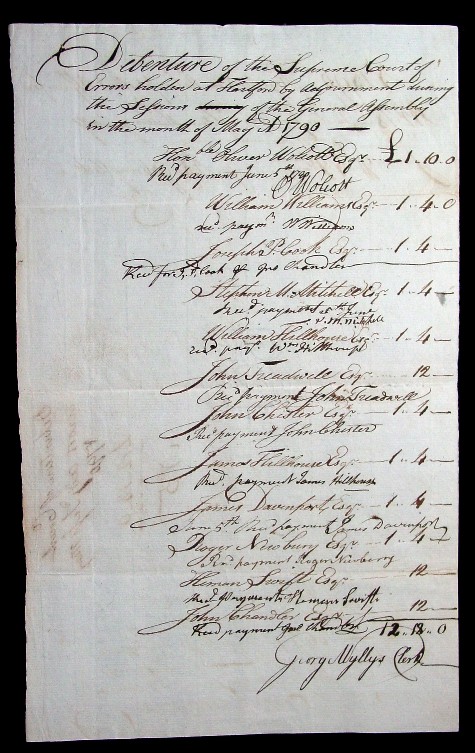
John Chandler was a member of the Hartford Convention that ratified the United States Constitution and made Connecticut the fifth state in 1788. On the whole, these rulers of Connecticut in 1790 had a distinguished military and government background which contributed much to the new republic. Below are some pictures of the large 1790 document with the signatures of the men described above.
The document is 12 1/8 x 7 3/8 and would thus not fit in our scanner as shown in the picture above. In the actual document the clerk's signature is not cut off and there is an ample margin on the bottom of the document as shown by the digital camera picture below. The document above does a better job of capturing the actual color of the document. The reverse of the document, which shows through on the left side of the scan, is the registration of the amount and purpose of payments in the Comptroller's office, the means of recording and fiscal control in those days.
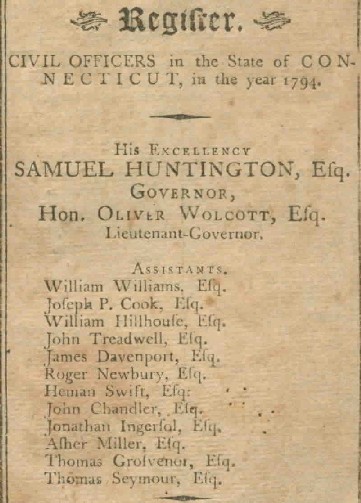
----------------------------------------------------------------------------------------- Below is a picture of the Connecticut Register for 1794 (available for purchase here) which lists the Governor, Lieutenant-Governor and Assistants in order of seniority. As you can see Lieutenant-Governor Wolcott is in the same position as in 1790 and eight of the twelve Assistants are the same as in our 1790 document.
The original Connecticut Charter of 1662 provided for the offices of Governor, Lieutenant Governor and twelve assistants and there was not much change from then until the new Constitution was adopted in 1818. As noted at the top of the description, the document says it is a "Debenture of the Supreme Court of Errors." Thus is appears that the Assistants had a dual function as both the upper chamber of the legislature as well as the highest level of the judiciary in Connecticut. This is supported by a number of web references. One web site describes an evolution of functions of the Assistants in the upper house and the deputies in the lower house:
Another web site, citing from Alexander Johnston's CONNECTICUT: A Study of a Commonwealth-Democracy at page 190, gives the specific timing of the evolution of the Assistants into the Supreme Court of Errors,
These governmental arrangements in Connecticut which gave the Governor and Assistants a combination of executive, legislative and judicial powers, were inconsistent with the federal government, for which the Constitution mandated a clear separation of powers. This was remedied in 1818 by a new state constitution, but in 1790 when our document was signed the twelve signers had extraordinary powers of governance over the citizens of Connecticut. This unique document signed by Declaration of Independence signers, Revolutionary War officers, Continental Congress delegates, United States Senators and Governors, is a wonderful piece of Connecticut, United States, legislative, judicial and military history. Price: SOLD |